

Beetroot

Nutritional Benefits
The beetroot leaves can be cooked and make a tasty spinach alternative and are rich in vitamin A. The beet is rich in vitamin C and antioxidants. They can be cooked and eaten warm or cold as a salad. They are also juiced.

The plant
Strictly speaking, beetroot is the edible taproot of the beet plant. It’s a close relative of Swiss chard and sugar beet, and has many health benefits. High-quality beets have a high sugar content and dark internal colour. The tasty young leaves are a good source of Vitamin A and can be prepared in the same way as Swiss chard. The purple roots are rich in Vitamin C.
Soil type and pH
Sandy to deep, well-drained sandy loam or silt loam, high in organic matter, is recommended for beetroot. Uniform soil moisture is essential for good quality. If the soil is compacted or the clay content is very high, roots are likely to be deformed and to develop a tough texture that reduces quality. Beetroot thrives in deep, rich sandy loam, with a pH of between 6 and 6,5.
Growth period
Beetroot will be ready to harvest six to nine weeks after sowing.
Irrigation
The soil should never be allowed to become dry and it should be kept moist to a depth of 20 to 25 cm. The plantings should receive light water applications daily until the young seedlings come up. About 30 mm of water should be supplied per irrigation.

Frequent pests
Frequent pests of beetroot include: aphids, red spider, leaf-eating insects, and cutworms. Control can be done by applying registered chemicals and using baits when the roots reach maturity. (Use registered chemicals.) Crop rotation can also help.
Diseases
Frequent diseases include: Cercospora leaf spot, downy mildew, brown rust, scab, root rot, and damping-off. Control can be achieved by sowing seeds in soils with a good structure. Seed should be treated with thiram. Practise crop rotation. The crop should have sufficient boron. Planting should be at the right time and not too deep. In the case of downy mildew, seeds should be obtained from an area where this disease does not occur. Seed treatment: place in hot water at 50 °C for 25 minutes. Practise crop rotation. Planting should be in well-drained soils.

Fertilisation Timing
Nitrogen fertilising is important and 300 to 400 kg/ ha of limestone ammonium nitrate or ammonium sulphate, depending on soil analyses, are applied in 2 or 3 dressings during the growing season. About 150 kg/ ha of nitrogen is usually applied at planting time and the rest when the plants are about 10 to 15 cm tall. A total of 500 to 600 kg/ha of superphosphate and 200 to 300 kg/ha of potassium chloride are applied just before sowing. Alternatively, a fertiliser mixture of 2:3:2 (22) at 1 000 to 1 200 kg/ha may be applied.
Sowing and Planting Time
The best planting times for beetroot are spring and autumn; the crop does well during summer on South Africa’s Highveld and winter in the Lowveld. The optimum temperature for growth is between 15°C and 20°C. Beets are not particularly sensitive to heat as long as there is enough moisture in the soil.
Planting Method
Seeds are spaced 25 to 50 mm apart in rows drawn 200 to 400 mm apart. A final in-row spacing of 50 to 70 mm after thinning out is recommended. The seed should be sown at a depth of 15 to 20 mm. About 6 to 10 kg of seed is needed for 1 ha of beetroot. The seed can be sown in beds or broadcast in large fields and later worked into the soil with a tractor-drawn harrow. The sowing times differ with production areas.
Fresh from the Kitchen
using Beetroot
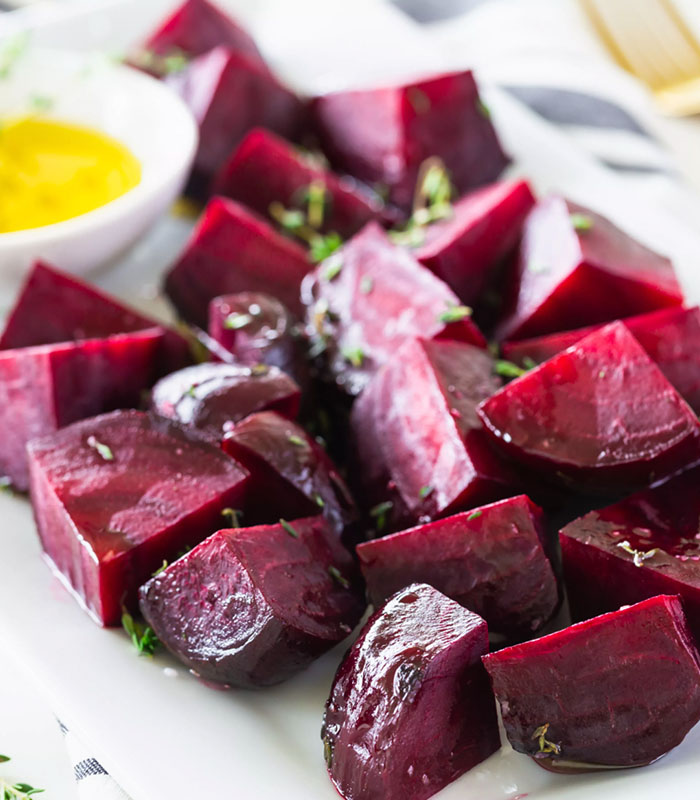
Roast Beetroot
The roasted beetroot is excellent on its own and a great side dish with any meat. It also works well with soft goat’s milk cheese and seasonal greens in a salad.

Beetroot and Feta Salad
Prepare to have one of the best combinations for a salad – beetroot and feta cheese. Beetroots have this sweet flavor and it’s perfectly balanced by the feta cheese.

Blueberry Beet Smoothie
Sweet, creamy, and packed with fiber, protein, and antioxidants! This healthy breakfast smoothie is perfect for weightloss or for kids.

Contact Us
Complete the form below
or call us on +27 (0)11 825 0659

We'd like to hear from you
Our team of experts is on hand to answer your questions.
In compliance with the new POPI Act, please take note of our Privacy Policy